July 4, 2026 Culture & towns
What to see in Gallipoli old town: a guide to the historic centre
From your base in Baia Verde, Gallipoli's old town is just a few minutes away by car or bike, and once there it is easy to explore entirely on foot: castle, baroque cathedral, underground olive mills and a walk along the sea walls, all in a single day.
A town on an island: how the old town is laid out
Gallipoli's old town sits on a small limestone island, separated from the mainland by a channel and linked by a 17th-century multi-arch bridge. Once across the bridge, the streets narrow into a maze of whitewashed lanes, inner courtyards and small squares that open up unexpectedly between a church and a noble palace. The main axis is Via Antonietta De Pace, which together with Via Duomo runs the length of the old town and links almost all of its main sights: from here it's hard to get lost, since the fortified perimeter always leads back to the sea. It's a small historic centre, walkable in little more than an hour, manageable even if you only have half a day.
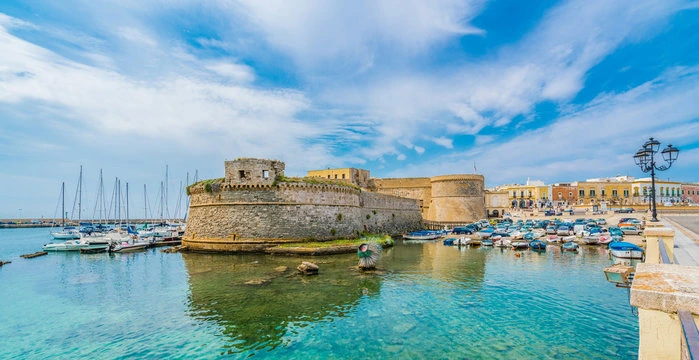
Angioino Castle, the symbol of the old town
The origins of Angioino Castle probably date back to the 11th century, built over Roman and Byzantine fortifications; it was restructured in the 13th century under Frederick II of Swabia and expanded in 1320 under the Angevins, from whom it takes its name. Between the 15th and 16th centuries it was surrounded by a moat filled with seawater, no longer visible today: in 1522 a rivellino was added, a separate fortification surrounded by water. The current quadrangular layout, with three round towers and a polygonal tower, reflects these centuries of defensive works. In high season the castle often hosts temporary exhibitions and cultural events in its inner courtyard: check the current programme and opening times before visiting.
Sant'Agata Cathedral and Salento baroque
A short walk from the castle, Sant'Agata Cathedral is one of the finest examples of Lecce-style baroque outside Lecce itself: its facade in local carparo stone, completed in 1669, echoes the decorative solutions developed by Giuseppe Zimbalo across the province. Inside, a Latin-cross plan divided into three naves by twelve Doric columns holds twelve baroque altars and several 17th- and 18th-century paintings, including works by local painter Giovanni Andrea Coppola. The transept dome is dominated by the Martyrdom of Saint Agatha by Nicola Malinconico, a canvas of over one hundred square metres that alone is worth the stop. The cathedral is still deeply felt by the local community, especially during the patron saint's feast in early February.
The underground olive mills, a hidden heritage
Beneath the old town lies a less visible but striking heritage: an estimated thirty-five underground olive mills were once active, carved into the limestone and used mainly between the 16th and 19th centuries to produce the lamp oil that lit up the nights of cities like London, Paris and Vienna. They were built underground because the constant temperature better preserved the olives. One of the best known, dating back to the 17th century, lies beneath Palazzo Granafei on Via Antonietta De Pace and can now be visited on guided tours. It's a different way to discover Gallipoli's economic history, away from the beaches and the most photographed landmarks.
Walls, bastions and the seafront walk
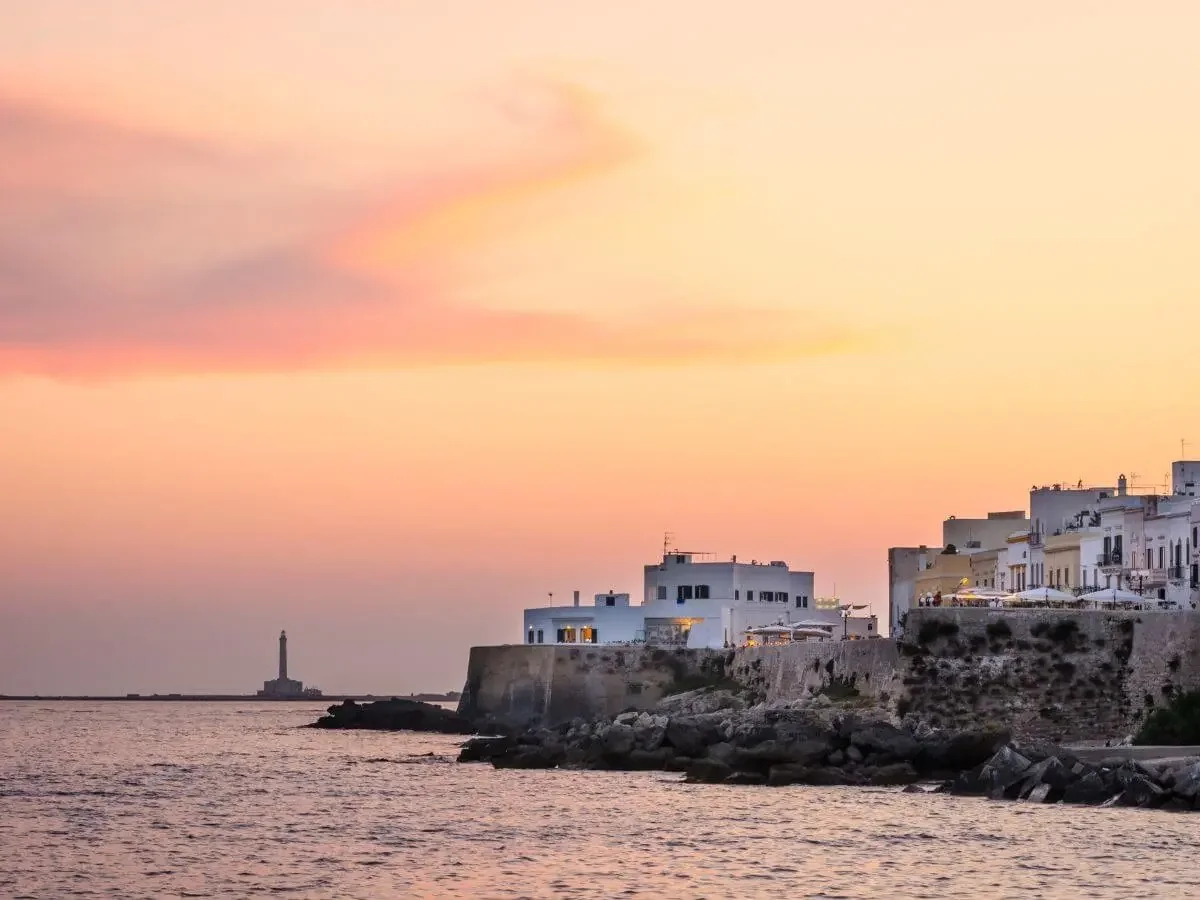
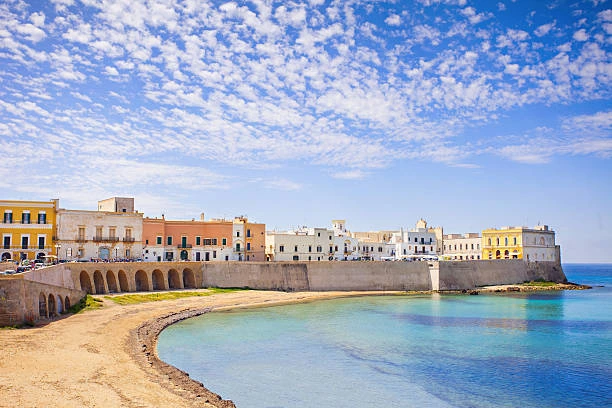
The fortified perimeter around the island offers one of the town's most beautiful walks: strolling along the walls and bastions gives you constant views over the open sea, the harbour and the new town stretching towards the mainland. The route is almost entirely flat, easy to manage even with children or after a day at the beach. Late afternoon remains the best time to catch the sunset from the west-facing bastions, with the sky lighting up over the water and boats returning to harbour: it's worth saving this walk for the end of the day.
Churches, palaces and lanes of the old town
Beyond the main landmarks, the old town's charm also lies in its smaller fabric: quieter churches often closed outside service times, noble palaces with carved Lecce-stone doorways along the main streets, and side lanes that open unexpectedly onto small squares or glimpses of the sea. It's the kind of discovery best made without a fixed destination, letting curiosity guide you from one street to the next.
- Historic churches around the old town, often with baroque facades
- Noble palaces along Via Antonietta De Pace and the main streets
- Side lanes and small squares, ideal for an aimless stroll
The Greek Fountain, the oldest threshold of the town
At the threshold between the old town and its more modern side stands the Greek Fountain, one of the oldest fountains in Italy. Its exact origin is debated among scholars: local tradition attributes it to Hellenistic populations of the 3rd century BC, while more recent research places it in the Renaissance. Its two facades, supported by caryatids, are decorated with bas-reliefs telling the mythological transformations of Dirce, Salmacis and Byblis, female figures turned into springs, while above stands the coat of arms of King Philip II of Spain. They remain among the most photographed details of the old town.
The harbour, the fish market and Spiaggia della Purità
The harbour is still a lively spot, with fishing boats moored and a striking view over the channel separating the island from the mainland, especially when boats return in the late morning. Nearby, the fish market is a good place to see the day's catch, still very much part of the town's identity rather than just a tourist attraction. Spiaggia della Purità, tucked between the houses of the old town right beneath the walls, offers a different experience from the open sea at Baia Verde: small, urban, often lively, perfect for a quick swim halfway through your visit.
Tips for visiting: when to go and how much time you need
The old town can be visited year-round, but in high summer the middle of the day is often hot and crowded: early morning or late afternoon remain the best times, with softer light for photos and quieter lanes. If you have a full day, you can alternate visiting the landmarks with slower stops at a café or ice-cream shop overlooking the sea, letting curiosity guide you among the smaller streets. Wear comfortable shoes, since the ground is almost everywhere stone, and dress appropriately if you plan to step into the cathedral or other churches.
How to plan your visit to the old town
Overall, the old town is easy to visit on foot in half a day, with a few extra hours if you also want to stop at the underground olive mills or the main churches. If you're staying in a holiday apartment in Baia Verde, you can reach the old town in a few minutes by car or by bike along the coast, and be back on the beach right after your walk — perhaps in time for a late-afternoon swim.